What is a Centrifugal Pump, and How Does it Work?
Have you wondered about the tap water you consume, how it comes to your tap, or how millions of litres of fluid are moved in refineries? Well, both questions have the same answer: it’s the involvement of centrifugal pumps. An equipment, very simple but has a complex image in front of almost everyone.
In this, you will get a 360-degree clarity about the centrifugal pump. Its variants, the physics behind it, their use cases, and what you should look for when buying one.
What is a Centrifugal Pump?
A centrifugal pump is a kind of pump that spins fluid outward and gives it momentum to push through a pipe system by converting rotational kinetic energy into hydrodynamic energy in the fluid.
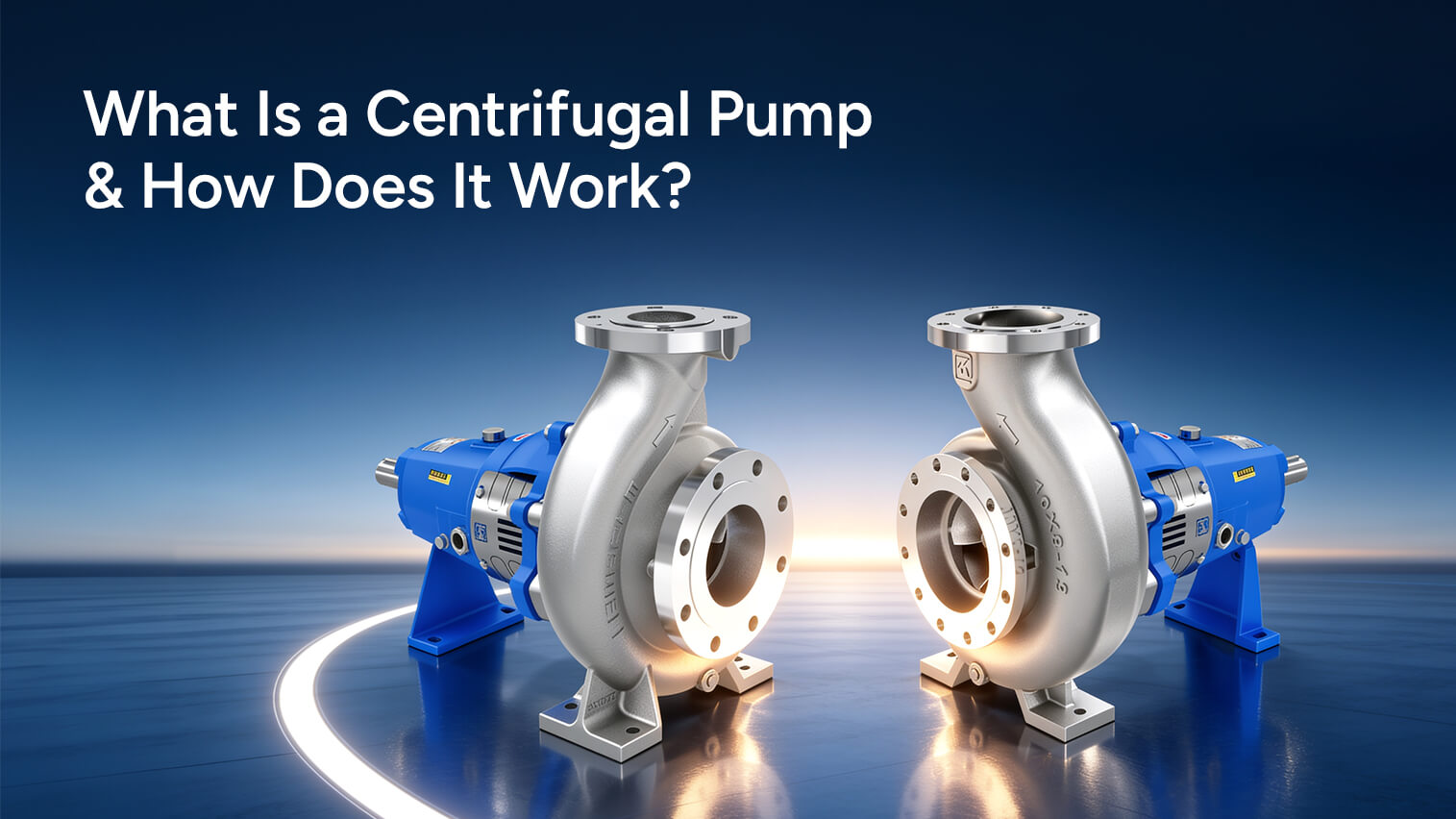
A basic centrifugal pump consists of an impeller, a volute casing that surrounds the impeller, a shaft that connects the motor to the impeller, and inlet and outlet ports. And that’s it! A simple design that does complex work.
How Does a Centrifugal Pump Work?
Centrifugal force operates via the principle of centrifugal force. The same force that pushes water outward while you swing the bucket around.
Here’s the detailed process
- Fluid enters the pump through the inlet to the centre.
- The impeller rotates at high speed. The curved vanes formed inside the pump catch the fluid and push it outward from the centre to the outer edge.
- The push increases the fluid’s velocity and ultimately the kinetic energy too.
- The volute casing collects the high-velocity fluid and slows it down in a controlled way, converting velocity into pressure.
- Due to the pressure incurred by the fluid, the fluid exits through the discharge outlet and flows through the pipes.
The process periodically repeats till the motor runs. A very simple machine that flows fluid flawlessly.
Types of Centrifugal Pumps
There are several kinds of centrifugal pumps. They differ in design and duties. The section will cover the variants of centrifugal pumps:
- Single-stage pumps: Consist of one impeller and are commonly used in water supply, HVAC, and irrigation systems.
- Multiple stage pumps: Consists of 2 or more impellers in series that add extra pressure. Multiple impellers in series, each adding pressure, are commonly used in boiler feeds and high-rise buildings’ water supply systems.
- Axial flow pumps: The axial pump moves fluid along the pump’s axis rather than driving it outward and is commonly used in flood control and irrigation canals.
- Mixed flow pumps: A mix of hybrid and axial designs, moderate flow with a medium-sized head.
- Submersible pumps: The pump and motor are submerged underwater, and the only visible part is the pipe coming up out of the ground. Submersible pumps are commonly used in drainage and deep well applications.
- Self-priming pumps: Self-priming pumps are built to evacuate air from the suction line without priming and are commonly used in settings where pumps sit above the fluid source.
Key Performance Parameters
Whenever you are evaluating the pump, as a buyer or an engineer, the following points are to be kept in mind to conclude, as they are the parameters that define its performance. The parameters should be present inside the brochure or should be clarified by the centrifugal pump manufacturers
- Flow rate (Q): It’s the volume of fluid passed through the pump per unit of time. Usually expressed in litres per minute and cubic meters per hour.
- Head (H): The pressure the pump generates, expressed as the equivalent height of a fluid column in metres, is called head. A higher head means the pump has higher resistance against fluids.
- Efficiency (η): How efficiently the pump converts the motor’s input into useful hydraulic output.
- Net Positive Suction Head (NPSH): The minimum pressure essential to prevent the pump inlet from cavitation.
- Best Efficiency Point (BEP): The most efficient flow rate at which the pump operates. If there is a huge difference between the flow rate and BEP, it could result in an increase in wear and energy consumption.
Where Are Centrifugal Pumps Used?
Being a simple pump, centrifugal pumps are supplied by leading centrifugal pump manufacturers for almost every sector that operates fluid movement.
- Wastewater treatment: Desalination and sewage transfer plants.
- Oil and gas: Pipeline transfer, refinery processes
- Power sector: Boiler feed pumps, cooling tower
- Chemical sector: Process fluid transfer, CIP cleaning systems
- Agriculture sector: Distributing water across the field areas
- HVAC: Chilled water circulation, cooling systems.
Choosing a Supplier
While finalizing and then purchasing a centrifugal pump the quality of the When sourcing a centrifugal pump, the quality of the centrifugal pump manufacturer matters as much as the specification. Established and trusted centrifugal pump suppliers will offer hydraulic performance data, material traceability, spare part support, and will be compliant with major pump certifications. Always request a pump curve for your specific duty point and verify that the operating point sits close to the BEP.
Frequently Asked Questions
Q: What is the main difference between a centrifugal pump and a positive displacement pump?
A centrifugal pump uses kinetic energy and hydrodynamic energy to spin fluid and throw it outwards, and it works better at moderate pressure and high flow rate. On the other hand, a positive displacement pump carries a fixed volume of fluid and forces it through with each stroke for high-pressure and viscous fluid duties.
Q: Why does a centrifugal pump lose performance with viscous fluids?
Viscous fluids have a tendency to resist flowing outwards and increase fluid friction, ultimately reducing the energy transfer efficiency. As viscosity rises, flow rate drops, head decreases, and power consumption increases. A more specialised pump would be required in the case of viscous fluids.
Q: What causes cavitation, and how do you prevent it?
When the pressure at the pump inlet drops below the NPSH, it causes water vapour to form, which is called cavitation. The bubbles collapse as they move into higher-pressure regions and erode the impeller and the volute casing over time. To prevent it, ensure that sufficient NPSH is achieved by reducing suction pipe losses, reducing the fluid’s temperature, and selecting a pump with a lower NPSH required rating.
Q: What materials are centrifugal pump casings made from?
It mostly depends on the operating conditions. For non-corrosive duties, cast iron is used. For handling corrosive materials and food-grade applications, stainless steel is used. For marine seawater service, bronze and gunmetal are used. So, for different domains of usage, different materials are used to build the pump casings.
Insights about
your industry
Understanding Hot Oil Pumps & Their Uses