Types of Centrifugal Pumps Explained
Centrifugal pumps are commonly used in industries that require fluid movement to deliver output. Industries ranging from water treatment, agriculture to oil& gas and chemical industries. Each industry utilizes a different kind of centrifugal pump according to their requirements. This guide will help you to decide which kind of centrifugal pump you would need for your business. Whether you are an engineer, a procurement professional or a facility manager, we know how crucial it is for you to choose the right pump and we would like to help you decide it.
Knowing the following variants of centrifugal pumps can help you ensure that your project/facility gets optimum output, efficient performance and a machine with a good longevity.
What is a Centrifugal Pump?
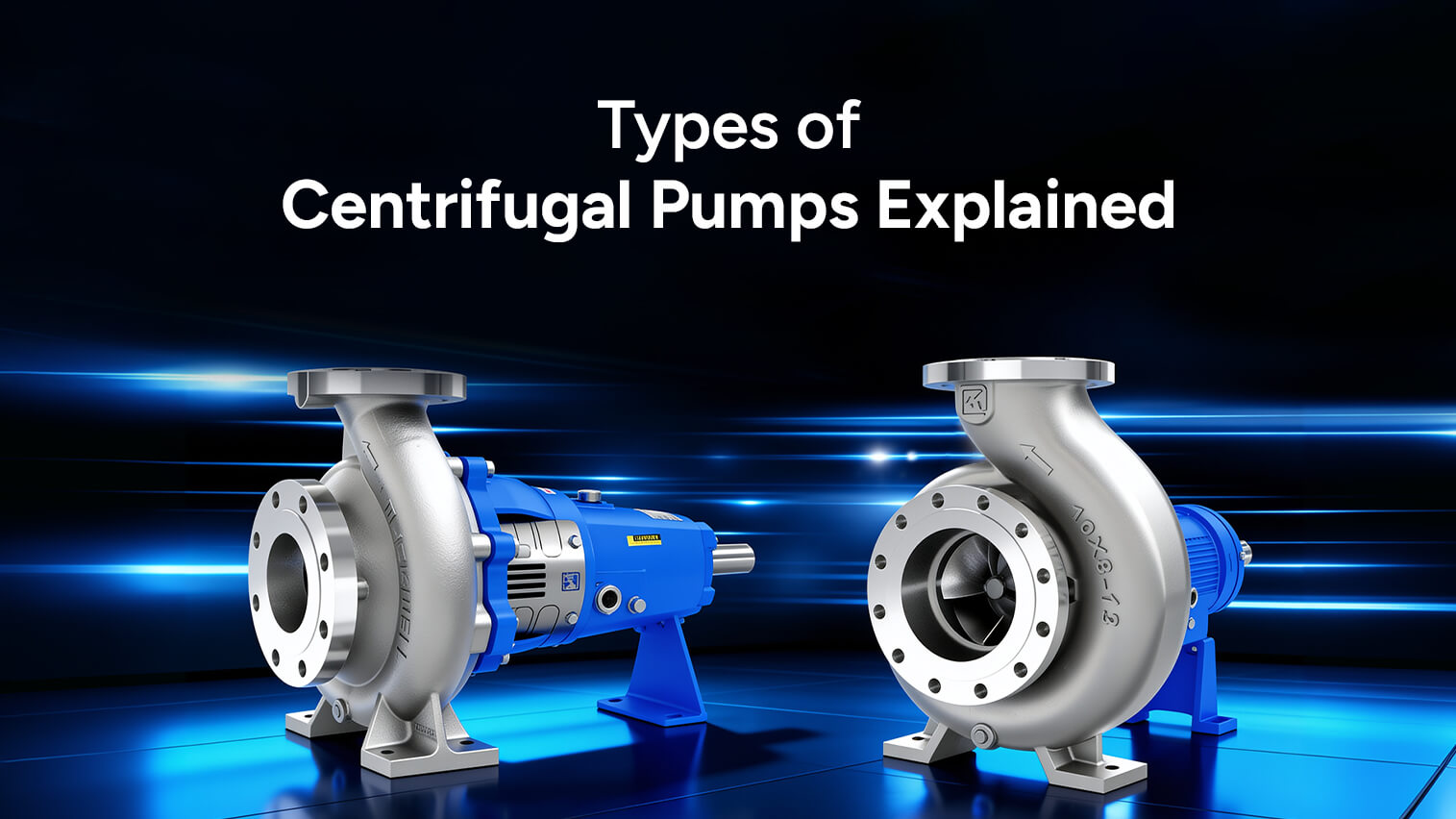
We are assuming that you want to know about centrifugal pumps right from the basic, so let us define it for you. So, a centrifugal pump is a device that uses hydrodynamic energy by converting it from rotational kinetic energy to move fluid from one place to another. A basic centrifugal pump consists of an impeller, volute casing, inlet port, outlet port, shaft, mechanical seal and bearings.
The components when put together for a simple design, high flow rate, low maintenance and adaptable machine that are trusted for a broad range of applications. They also come in variants, each variant is designed to address specific operations.
Types of Centrifugal Pumps
1. Single Stage Centrifugal Pumps
A single stage centrifugal pump contains only one impeller mounted on a shaft. They are cost effective, easy to maintain and available at every centrifugal pump supplier at a competitive price.
The pump is commonly used in:
- Water supply and distribution
- Irrigation systems
- HVAC circulation
- General industrial fluid transfer
2. Multi-Stage Centrifugal Pumps
If the pump features two or more impellers arranged inside the pump, then it is a multi stage centrifugal pump. Each of the stage is responsible for adding pressure to the fluid that allows the pumps to achieve significantly higher discharge pressures, which makes them an ideal setup for:
- High-pressure boiler feed systems
- Reverse osmosis and desalination plants
- Deep well pumping
- Oil and gas pipeline boosting
Centrifugal pump manufacturers like Mackwell have variants designed to be wear resistant and handle high pressure operations.
-
Axial Flow Pumps
Axial flow pumps are famous due to their ability to move fluid parallel to the pump shaft using an impeller that resembles a propeller. They are optimised for operations that demand the pump to maneuver at very high flow rates at low heads. The axial flow pumps are commonly used in high volume and low pressure applications like flood control, irrigation canals, and large scale water treatment facilities .
-
Radial Flow Pumps
In radial flow pumps, the fluid enters along the impeller axis and exits radially outward, perpendicular to the impeller axis. A traditional pump design, well suited for medium to high pressure, moderate flow applications. They are extensively used in chemical processing and water supply systems. Most standard pumps available from centrifugal pump suppliers fall into this category.
-
Mixed Flow Pumps
The mixed flow pumps are hybrid pumps that combine the designs of axial and radial flow designs. The hybrid design delivers moderate flow rates at moderate heads and the fluid here flows both axially and radially. They are commonly used in stormwater management and cooling water circulation systems in power plants.
-
Submersible Centrifugal Pumps
Just like its name, the submersible centrifugal pumps remain fully submerged under the water. A waterproof housing seals the motor and pump assembly. They are quite efficient and eliminate priming as they have a mechanism of pushing fluid rather than pulling it. The submersible centrifugal pumps are commonly used in drainage and sewage operations and also in mining and dewatering operations.
-
Self-Priming Centrifugal Pumps
Self-priming pumps stand out from the other pumps as they can evacuate air from the suction line and prime themselves automatically while the other pumps require priming ( filling with liquid) before starting. Self priming pumps are commonly used in pumping stations and sewage handling applications.
-
Vertical vs. Horizontal Centrifugal Pumps
- Horizontal centrifugal pumps – the most common type, easier to maintain and inspect, need priming and they are widely used in industries that require flooded suction supply ( where the liquid level already above the pump)
- Vertical centrifugal pumps – The best pumps for applications that have space issues. The shaft and impeller are oriented vertically, which saves a lot of floor space. suitable for sumps, pits, and tanks. As they are built with multi-stage units, they are excellent for high pressure applications like boiler feeds.
Working With Centrifugal Pump Manufacturers and Suppliers
Partnering with reliable centrifugal pump manufacturers ensures your access to quality pumps, after sales support, and special engineering reports. They also meet reputed and international standards such as ISO 9001, API 610, ANSI/HI, and DIN, ensuring trust and credibility.
While sourcing and purchasing through centrifugal pump suppliers always verify certifications and pump info.
Conclusion
The pump catalogue is very huge, pumps range from axial to radial, horizontal to vertical etc. This means there’s always a pump for every type of fluid operation. By understanding these distinctions and consulting with pump experts and centrifugal pump manufacturers, you can make informed decisions and finalize a pump that maximizes efficiency and is long lasting.
Frequently Asked Questions (FAQ)
Q1. What is the most common type of centrifugal pump?
The single stage radial flow centrifugal pump is the most widely used variant of centrifugal pump. It’s because it caters to a broad range of domains, is simple to use and is cost effective.
Q2. What is the difference between axial flow and radial flow centrifugal pumps?
Axial flow pumps tend to move fluid parallel to the shaft and are applied in applications that require very flow rates and low pressures. Radial flow pumps move fluid perpendicular to the shaft and are used in applications that demand moderate to high pressure and medium flow.
Q3. When should I choose a multi-stage centrifugal pump over a single-stage pump?
You should choose if your applications require low to moderate pressure. Multi stage centrifugal pumps are adequate for applications that require high discharge pressure, applications such as boiler feed systems and building’s water supply.
Insights about
your industry